Thermal-aware robotic manipulation

Thermal-Aware Vision-Language-Action Models with Gated Residual Fusion for Robotic Manipulation
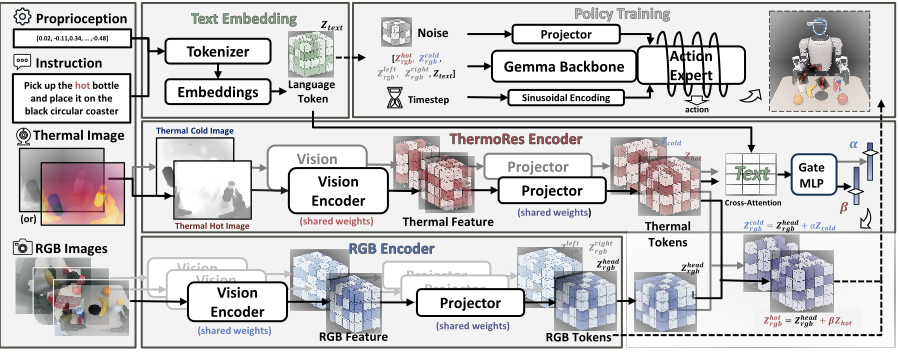
Recent Vision–Language–Action (VLA) models have begun incorporating thermal sensing, but existing approaches typically treat thermal images as ordinary visual inputs, providing limited support for temperature-aware relational reasoning in manipulation. To address this limitation, we propose Thermo-VLA with a ThermoRes Encoder, which decomposes thermal images into cold and hot attribute representations and injects them into the RGB token through language-conditioned residual modulation, enabling temperature-driven target selection and continuous manipulation. We further construct six real-world robotic tasks on a dual-arm Unitree G1 platform, spanning basic grounding to relational reasoning. Experiments show that Thermo-VLA achieves an average success rate of 0.86 across four thermal-dependent tasks, outperforming a π0.5 baseline that directly incorporates RGB–thermal observations by 18 percentage points. Under unseen-object and scene variations, Thermo-VLA maintains an average success rate of 0.78, achieving the best generalisation performance among the compared methods. Beyond thermal sensing, we transfer the same residual modulation mechanism to colour attributes and observe consistent improvements in both simulation and real-robot experiments, indicating its potential to generalise beyond thermal attributes.
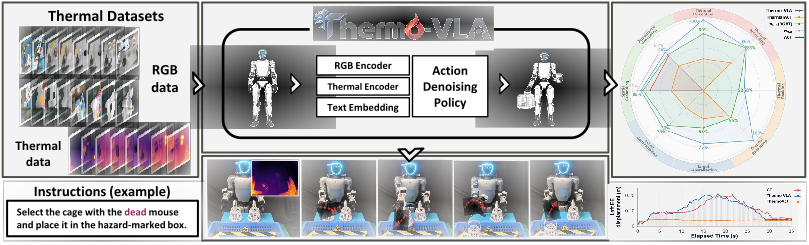
Comprising four temperature-related tasks and two RGB-based tasks for evaluating representative VLA methods under RGB and thermal settings.
Combining temperature-attribute decomposition and text-conditioned residual injection for temperature-driven manipulation.
Achieving the best overall performance on the proposed benchmark and showing strong generalisation to unseen objects and scene variations.
Thermo-VLA builds on a VLA policy and augments it with thermal attribute residuals. RGB observations are encoded by the RGB visual encoder, while language instructions and robot states are mapped to textual embeddings. ThermoRes Encoder decomposes thermal observations into cold and hot attributes and injects them into RGB tokens through context-gated residuals. The resulting multimodal prefix is used for flow-matching policy training and continuous action generation.
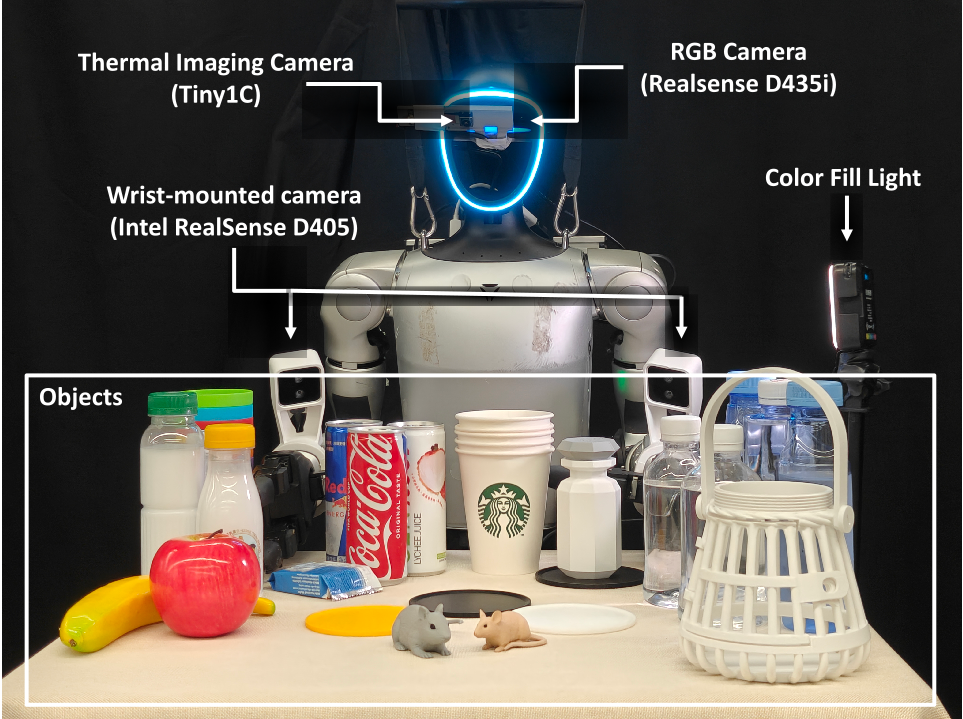
The experiments are conducted on a Unitree G1 EDU humanoid robot with Unitree Dex3-1 hands, a head-mounted Intel RealSense D435i RGB camera, two wrist-mounted RealSense D405 cameras, and a Tiny1-C thermal camera. Training is performed on an NVIDIA A800 80GB GPU, and policy inference runs on an NVIDIA GeForce RTX 5090 48GB GPU.
| Task | Difficulty | Episodes |
|---|---|---|
| I. Position-guided bottle selection | Spatial grounding | 156 |
| II. Temperature-guided bottle selection | Thermal perception | 303 |
| III. Identity-guided object selection | Appearance grounding | 236 |
| IV. Temperature-guided object selection | Thermal grounding | 340 |
| V. Temperature-aware coffee service | Thermal ranking | 173 |
| VI. Abnormal-animal cage removal | Thermal exclusion | 99 |
In the comparison experiments, Thermo-VLA achieves the best overall performance on the proposed benchmark while preserving strong RGB manipulation ability. Its advantage is most evident on temperature-dependent tasks that require relative thermal reasoning or exclusion of thermally abnormal targets.
| Task Avg. | ACT | π0.5 | π0.5 (RGBT) | ThermoAct | Thermo-VLA |
|---|---|---|---|---|---|
| I. Position-guided bottle | 0.75 | 0.93 | 0.85 | 0.45 | 0.88 |
| II. Temperature-guided bottle | - | - | 0.80 | 0.45 | 1.00 |
| III. Identity-guided object | 0.69 | 0.84 | 0.71 | 0.49 | 0.76 |
| IV. Temperature-guided object | - | - | 0.85 | 0.55 | 0.86 |
| V. Temperature-aware coffee service | - | - | 0.50 | 0.00 | 0.58 |
| VI. Abnormal-animal cage removal | - | - | 0.55 | 0.50 | 1.00 |
In the generalisation experiments, Thermo-VLA also maintains the strongest average performance under temperature reassignment, unseen objects, illumination changes, and unseen tablecloths, showing better robustness to both target and scene variations.
| Setting Avg. | ThermoAct | π0.5 (RGBT) | Thermo-VLA |
|---|---|---|---|
| Seen-object temperature reassignment | 0.50 | 0.10 | 0.60 |
| Unseen objects | 0.38 | 0.64 | 0.79 |
| Illumination change | 0.35 | 0.68 | 0.76 |
| Unseen tablecloth | 0.34 | 0.72 | 0.79 |
No demonstration videos found.
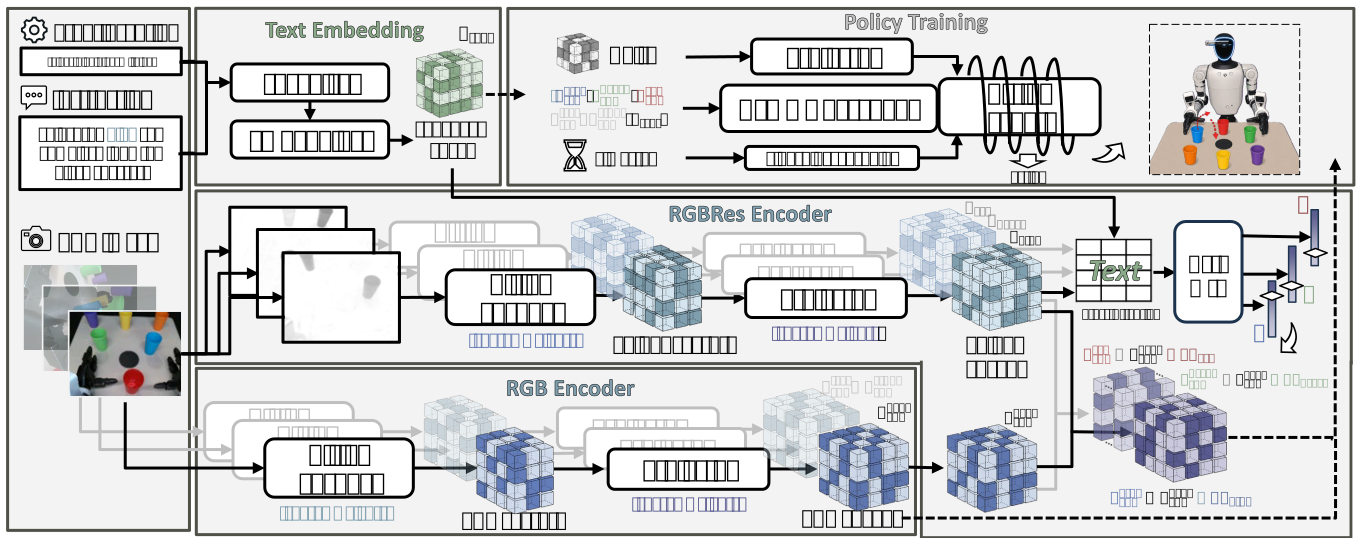
We further investigate whether these directions are thermal-specific or attribute-dependent by transferring the same residual mechanism to pure-RGB colour-conditioned tasks. we extend π0.5 with an additional RGBRes Encoder to introduce colour-guided residual modulation into the RGB visual representation.
To examine whether this structure extends to other attributes, we apply RGBRes to four pure-RGB colour-conditioned tests in simulation and the real world.
| Method | Task VII | Task VII (Tablecloth) | Task VIII | Task VIII (Tablecloth) | Avg. |
|---|---|---|---|---|---|
| π0.5 | 0.707 | 0.307 | 0.600 | 0.675 | 0.572 |
| π0.5 + RGBRes Encoder | 0.873 | 0.453 | 0.900 | 0.875 | 0.775 |
We further analyse the learned residual features with PCA across thermal and RGB tasks to verify whether the attribute corrections form a compact and consistent representation. Here, ηk denotes the cumulative centred PCA energy retained by the top-k principal components, and higher values indicate that the residual variation is concentrated in a lower-dimensional subspace.
| Task | Avg. Cosine | η4 | η8 | η16 | η32 |
|---|---|---|---|---|---|
| Task II | 0.942 | 54.2 | 66.1 | 74.5 | 83.1 |
| Task IV | 0.947 | 58.3 | 69.3 | 76.5 | 84.4 |
| Task VI | 0.956 | 69.6 | 79.6 | 84.5 | 89.6 |
| Task VII | 0.999 | 88.1 | 95.7 | 98.4 | 99.5 |
| Task VII(Tablecloth) | 0.999 | 84.8 | 94.0 | 97.6 | 99.1 |
We propose Thermo-VLA, which introduces a ThermoRes Encoder to inject temperature attributes from thermal images into RGB visual representations as text-conditioned residuals, enabling temperature-driven target selection and continuous manipulation while preserving fundamental vision–action capabilities. We establish a real-world benchmark on the Unitree G1 platform, covering RGB-only grounding, temperature-dependent manipulation, and thermal reasoning. Experiments show that Thermo-VLA achieves superior performance across the benchmark and diverse generalisation settings. Beyond thermal sensing, our results support low-dimensional attribute-conditioned residual modulation as a broader representation principle for augmenting generic vision-action representations with additional physical attributes.
This work is currently under review. © 2026 The Authors. All rights reserved.